How a Trusted CPU-Z Download Became a Silent Malware Attack: A Case Study in Supply Chain Security
Introduction
On April 9, 2026, a routine download from the official CPUID website turned into a sophisticated cyber attack. For nearly 19 hours, visitors who clicked the legitimate download button were served malware instead of the expected CPU-Z utility. The threat actors compromised the CPUID domain at the API level, silently redirecting download requests to attacker-controlled servers. Even users who navigated directly to the official site received a properly signed executable—but bundled with malicious code indistinguishable from the real application.

The Attack in Detail
The attack exploited a critical vulnerability in the software supply chain. The threat actors gained control over the CPUID API, allowing them to intercept download requests without altering the website's appearance or breaking the digital signature of the delivered binary. Users who downloaded CPU-Z, HWMonitor, or related tools followed every security recommendation—they used the official source, verified the signature, and still opened a backdoor into their systems. The trust chain broke at the vendor's infrastructure, not at the user's end.
Trust Chain Breakdown
This incident underscores a systemic shift in cyber attacks: attackers now target the identity and infrastructure of trusted developers rather than exploiting traditional endpoint vulnerabilities. As SentinelOne's Annual Threat Report highlights, 'the identity of a trusted developer becomes the vector of attack.' This pattern was previously observed in the GhostAction campaign (late 2025), where a compromised GitHub maintainer account pushed malicious workflows, and in NPM package attacks where maintainer credentials were phished to insert malicious code.
SentinelOne's Detection: Behavioral Anomalies
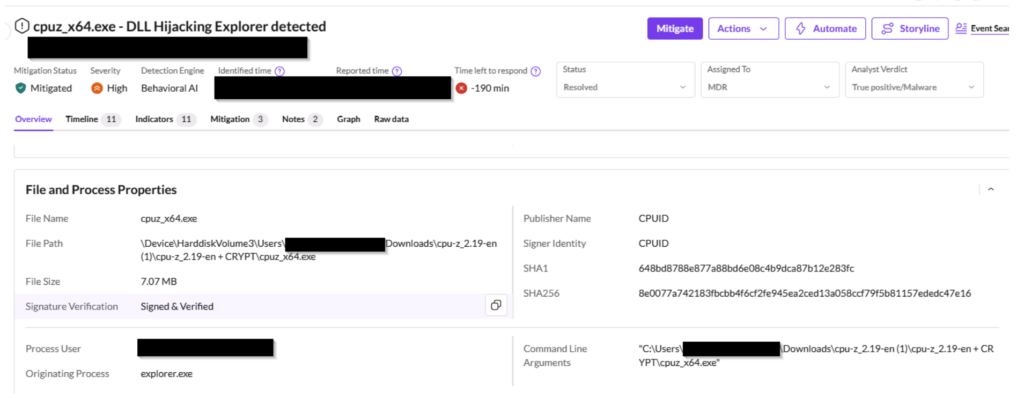
SentinelOne's AI-powered EDR agent did not rely on signature-based detection. Instead, it analyzed the behavior of cpuz_x64.exe in real time. The binary was genuine, the digital signature valid, and the download source legitimate—yet the agent flagged it within seconds of execution. The telltale sign was the process chain: cpuz_x64.exe spawned PowerShell, which then spawned csc.exe (the C# compiler) and cvtres.exe (the resource compiler). Normal CPU-Z processes never follow this sequence.
The agent identified the alert 'Penetration framework or shellcode detected' based on five converging behavioral indicators:
- Anomalous API resolution: The process located system functions through non-standard discovery methods, bypassing the OS loader entirely.
- Reflective code loading: Executable code ran from memory regions with no corresponding file on disk.
- Suspicious memory allocation: Read-Write-Execute (RWX) memory permissions were requested—a classic staging pattern for malicious payloads.
- Process injection patterns: Execution flow consistent with code being redirected into a secondary process to mask its origin.
- Heuristic shellcode signatures: Sequential operations characteristic of automated exploitation toolkits preparing an environment for command execution.
Autonomous Response: Stopping the Attack in Seconds
Once these indicators converged, SentinelOne's agent acted autonomously. It terminated and quarantined the involved processes before the attack could advance further. The malicious payload—specifically a CRYPTBASE.dll placed in the application directory—was blocked from executing. This rapid response prevented data exfiltration, lateral movement, or potential ransomware deployment that often follows such initial access.
For a deeper dive into the behavioral indicators and how they mirror previous supply chain attacks, see the section below.
The Broader Supply Chain Threat
The CPUID incident extends a worrying trend in software supply chain compromises. Attackers are increasingly targeting the distribution pipeline itself. In the GhostAction campaign, a maintainer's GitHub account was used to push malicious CI/CD workflows that extracted secrets. Similarly, a phishing attack on an NPM maintainer led to malicious code intercepting cryptocurrency transactions. In both cases, commit logs appeared legitimate because they came from accounts with valid write access. The CPUID attack differs only in that it compromised the download infrastructure rather than the code repository—but the effect is the same: trusted software becomes a Trojan horse.
Parallels with GhostAction and NPM Attacks
While the CPUID attack used a watering hole approach, the underlying methodology mirrors these earlier campaigns. Attackers subvert identity verification systems—whether GitHub credentials, NPM tokens, or API keys—to deliver malicious code through trusted channels. The common thread is that traditional security measures (signatures, hashes, trusted sources) become useless when the supplier's infrastructure is itself the attack vector.
Lessons Learned: Behavioral Detection Is Essential
This case study highlights several key takeaways for organizations:
- Signatures are insufficient: Even properly signed binaries from official sources can carry hidden malware. Behavioral analysis of process chains and memory operations is critical.
- Runtime monitoring matters: EDR solutions that analyze execution behavior in real time can detect anomalies that static analysis would miss.
- Supply chain vetting must extend to infrastructure: Organizations should monitor not just the code they use but the integrity of the delivery mechanisms—API endpoints, download servers, and build pipelines.
- Autonomous response saves time: Manual investigation of such attacks would allow the malware to establish persistence. Automatic termination and quarantine contain the threat immediately.
Conclusion
The CPU-Z watering hole attack is a stark reminder that trust in the software supply chain is fragile. Attackers are evolving from exploiting endpoint vulnerabilities to subverting the identity and infrastructure of trusted vendors. Advanced behavioral AI EDR systems like SentinelOne provide a critical defense layer by detecting anomalies that no signature-based tool can catch. As the saying goes, 'The next attack will work the same way'—and only autonomous, behavior-focused protection can stop it.
Related Articles
- Linux Kernel Patches Partial Dirty Frag Vulnerability – Second Fix Still Pending
- How to Identify and Prosecute Ransomware Leaders: Lessons from the UNKN Case
- 8 Critical Insights Into the DarkSword iOS Exploit Chain
- Weekly Cyber Threat Intelligence: Q&A on Recent Attacks, AI Threats, and Patches
- Understanding Anthropic's Mythos: A Step-by-Step Guide to Its Cybersecurity Implications
- Massive iOS Exploit Kit 'Coruna' Spotted in Wild: Google Reveals 23 Flaws Used in Targeted Attacks
- Cybersecurity Experts Sentenced to Prison for Role in BlackCat Ransomware Campaigns
- AWS Names First 2026 Heroes Cohort: Three Community Leaders Recognized for Cloud, AI, Security Impact